
agitator & reactor seals


Reliable Mechanical Sealing Solutions for Agitators, Mixers & Reactor Vessels
Lova-Tech Industries manufactures and supplies Agitator & Mixer Mechanical Seals designed for reliable sealing of rotating shafts used in industrial mixers, agitators, reactors and processing vessels.
Our agitator seals are available in different configurations to suit top-entry, bottom-entry and side-entry agitators, as well as various vessel and reactor arrangements. Depending on the process requirements, we can offer single mechanical seals, double mechanical seals, dry-running seals and liquid-lubricated sealing systems.
We support standard as well as customized mechanical seal requirements based on shaft diameter, vessel design, operating pressure, temperature, speed, process media and installation arrangement.
Mechanical Seals for Agitators, Mixers & Reactors
Agitator and mixer shafts operate under different process conditions compared with conventional pump applications. The sealing system must withstand shaft movement, process pressure, temperature, chemical exposure and, in some applications, vacuum conditions.
Lova-Tech Industries provides mechanical sealing solutions for applications where preventing process leakage, contamination and atmospheric ingress is important.
Our agitator mechanical seals can be designed for
-
Industrial agitators
-
Process mixers
-
Reactor vessels
-
Chemical reactors
-
Pharmaceutical mixing vessels
-
Stainless steel vessels
-
Glass-lined reactors
-
Food & beverage mixers
-
High-viscosity mixing applications
-
Vacuum and pressure vessels
-
Special-purpose mixing equipment
Agitator Seal Configurations
Top Entry Agitator Seals
Top-entry agitators are commonly installed through the upper portion of the vessel or reactor. Mechanical seals are mounted around the vertical agitator shaft to isolate the process inside the vessel from the atmosphere.
Top-entry mechanical seals can be supplied in:
-
Single seal configuration
-
Double seal configuration
-
Liquid-lubricated design
-
Dry-running design
-
Cartridge seal arrangement
-
Seal with integrated or separate bearing
-
Customized vessel flange arrangements
* Specialized single and double mechanical seal arrangements can be selected according to the application.

Bottom Entry Agitator Seals
Bottom-entry agitators are installed through the bottom of the vessel. The seal is exposed to the process conditions and may experience pressure from the product above the sealing area.
Bottom-entry applications require careful consideration of:
-
Process pressure
-
Product characteristics
-
Shaft alignment
-
Seal face lubrication
-
Temperature
-
Shaft speed
-
Product solids or viscosity

Single Mechanical Seal
A single agitator mechanical seal provides one primary sealing interface between the rotating shaft and stationary housing.
Single seals can be suitable for applications where:
-
Process conditions are moderate
-
Leakage requirements are less stringent
-
The process medium provides adequate lubrication
-
A simple and economical sealing arrangement is preferred
Dry Running Agitator Seals
Some agitator and mixer applications require the seal to operate without conventional liquid lubrication at the seal faces.
Dry-running mechanical seals can be designed for suitable applications where process conditions, speed, temperature and seal-face materials allow dry operation.
Dry-running agitator seals are used in selected:
-
Chemical processes
-
Pharmaceutical processes
-
Food & beverage equipment
-
Mixers
-
Reactors
-
Non-toxic process applications
The allowable pressure, temperature and sliding speed depend on the particular seal design and operating conditions. For example, published industrial dry-running agitator seal designs can have application-specific limits such as vacuum to several bar pressure, temperature ranges around -20°C to +150°C, and sliding speeds up to approximately 2 m/s; these values are not universal ratings and must be confirmed for the selected seal.
Side-entry mixers are installed through the side wall of the vessel or tank. These applications are commonly found in mixing tanks, storage vessels and industrial process equipment.
Mechanical seals for side-entry applications can be selected according to shaft arrangement, process pressure, speed, temperature and product characteristics.
Side Entry Agitator Seals
Double Mechanical Seal
A double mechanical seal uses two sealing faces with a barrier or buffer system between them.
Double seals are commonly considered where improved leakage control, contamination protection or demanding process conditions require a more controlled sealing environment.
Depending on the application, the system may use:
-
Liquid barrier fluid
-
Buffer fluid
-
Gas barrier
-
Pressurized dual seal arrangement
Liquid-Lubricated Agitator Seals
Liquid-lubricated seals use a suitable fluid around the sealing faces to provide lubrication and remove heat.
Depending on the design, the sealing system may use:
-
Barrier fluid
-
Buffer fluid
-
Cooling fluid
-
Flushing arrangement
-
Circulation system
Liquid-lubricated agitator seals are available for demanding applications in chemical, pharmaceutical, petrochemical, food and beverage and other process industries

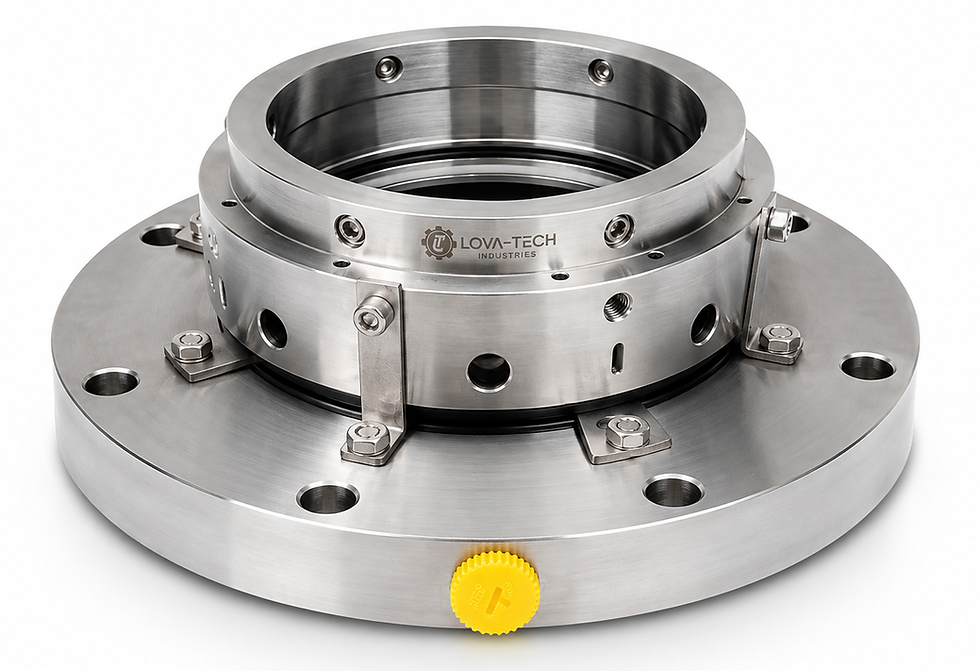
Double mechanical seals are particularly useful for demanding chemical, pharmaceutical, food-processing and reactor applications where process integrity is important
Single seals can be supplied for both liquid-lubricated and selected dry-running applications.
Mechanical Seals for Reactor Vessels
Mechanical seals are an important part of reactor vessel sealing systems, particularly where the agitator shaft passes through the vessel wall.
Lova-Tech Industries can supply sealing solutions for:
-
Chemical reactors
-
Glass-lined reactors
-
Stainless steel reactors
-
Process vessels
-
Pharmaceutical reactors
-
Mixing vessels
-
Vacuum vessels
-
Pressurized vessels
Seal construction can be selected according to vessel design, shaft dimensions, flange arrangement and operating conditions.
Operating Conditions
Agitator mechanical seals can be engineered for different operating conditions depending on the seal construction, materials and application.
Pressure
Depending on the seal type and process, applications may include:
-
Vacuum service
-
Atmospheric pressure
-
Pressurized vessels
-
Higher-pressure reactor applications
Published agitator seal products show significantly different pressure capabilities; therefore, pressure should always be selected according to the specific seal design rather than using one generic rating.
Temperature
Mechanical seal temperature capability depends on:
-
Seal face material
-
Secondary seal material
-
Metal components
-
Process medium
-
Lubrication/barrier system
-
Cooling or heating arrangement
For this reason, Lova-Tech can select suitable materials and construction according to the actual operating temperature.
Speed
Agitator speed is generally specified in RPM or shaft surface/sliding velocity.
Seal selection depends on:
-
Shaft diameter
-
RPM
-
Seal-face diameter
-
Seal design
-
Lubrication condition
-
Process medium
High-speed and low-speed agitators may require different seal constructions.
Process Media
Agitator and mixer seals can be designed for a wide range of process media, subject to material compatibility and operating conditions.
Typical applications include:
Chemical Media
-
Acids
-
Alkalis
-
Solvents
-
Chemical solutions
-
Corrosive liquids
Pharmaceutical Media
-
Active ingredients
-
Formulations
-
Suspensions
-
High-purity process fluids


Food & Beverage Media
-
Food products
-
Dairy products
-
Beverages
-
Syrups
-
Edible oils
Other Process Media
-
Water-based products
-
Oils
-
Resins
-
Adhesives
-
Slurries
-
High-viscosity products
-
Suspensions
-
Products containing solids

Custom Agitator Mechanical Seals
Every agitator or reactor is not necessarily built to the same dimensions. Lova-Tech Industries therefore supports custom mechanical seal requirements based on:
We can manufacture or supply replacement seals based on drawing, sample, dimensions or existing seal details.
Reverse engineering support can also be considered when the original drawing or manufacturer's seal identification is unavailable.
-
Shaft diameter
-
Seal chamber dimensions
-
Mounting flange
-
PCD
-
Vessel dimensions
-
Working length
-
Operating pressure
-
Operating temperature
-
Shaft RPM
-
Process medium
-
Existing seal design
